Tells you what to lift next, based on what you actually lifted last.
Most training apps are a logbook. You write down what you did, and deciding what to do
next is still your problem. LiftMax does that part for you.
Free to download, with no account and no ads.
LiftMax Pro is a one-off unlock.
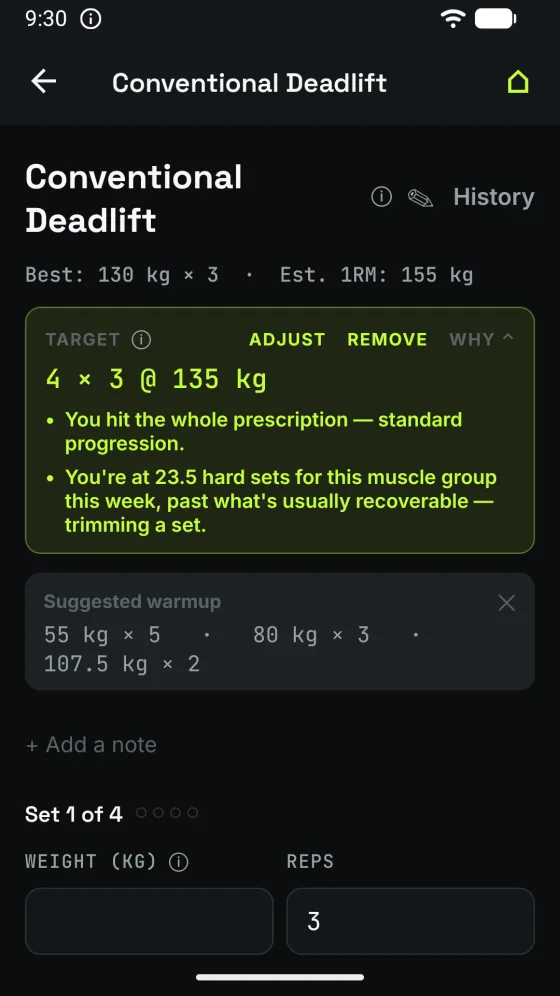
Next session
Barbell Bench Press
82.5 kg · 4 × 8
From your last 3 sessions and your estimated 1RM trend —
rounded to a load you can actually build.
These are the sessions it is reading. Change them and watch the
prescription move.
1
2
3
Estimated max
Trend
Warm-up
Running the app's own formulas, not a mock-up of them. Two
simplifications: each session here is summarised by one set where the app grades every
set you log, and the per-lift personalisation — your rep-max curve, your reps-in-reserve
bias — needs more history than three sessions, so it sits at the population default.
The engine
How it decides
Every set you log updates an estimated one-rep max for that exercise.
Prescriptions come off the trend across recent sessions rather than a single good day, so
one heavy session doesn't send the next one somewhere you can't follow. The newest session
carries four sevenths of the answer, the one before it two, the one before that one — no
single rating can ever be more than about half of it.
It also learns how you rate effort. Reps-in-reserve judgement is a skill, and
most lifters under-rate what they have left — which quietly drags every prescription too
light. LiftMax measures your personal bias and corrects for it.
Come back after time off and it backs the load off
Not by waiting for you to prove the loss with a bad session — by the calendar,
before you lift. Under ten days nothing happens, because strength is the slowest thing to
decay and a holiday costs almost nothing. Past six weeks it stops scaling, because the loss
is no longer predictable from time alone and your next few sessions are better evidence
than any curve.
Across the bottom, days since you last trained that exercise; up the side, how
much comes off the estimate before the next prescription is priced. The reduction is
applied to the estimate, not the finished weight, so the plate rounding and your goal's
own percentage band still do their usual jobs against a basis that admits time has
passed. There is no counter ramping it back out — the reduced session writes its own
estimate, so a lifter who was genuinely detrained climbs back gradually and one who
handled it easily rebounds almost at once.
In the app
What it looks like
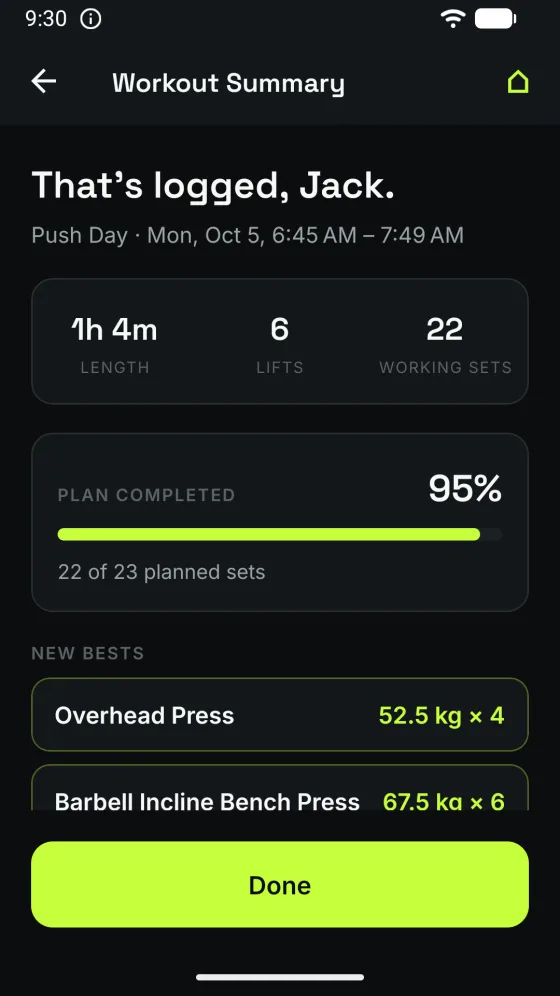
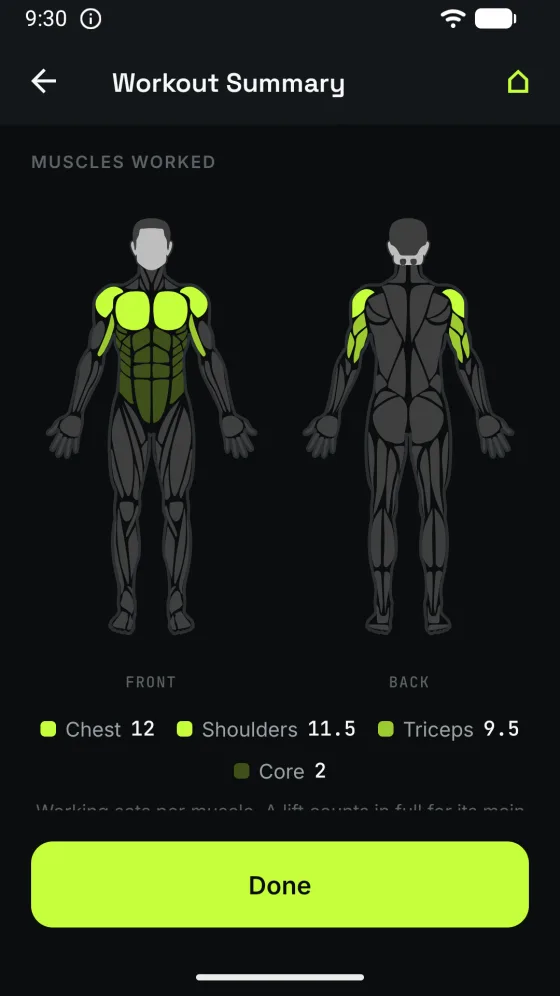
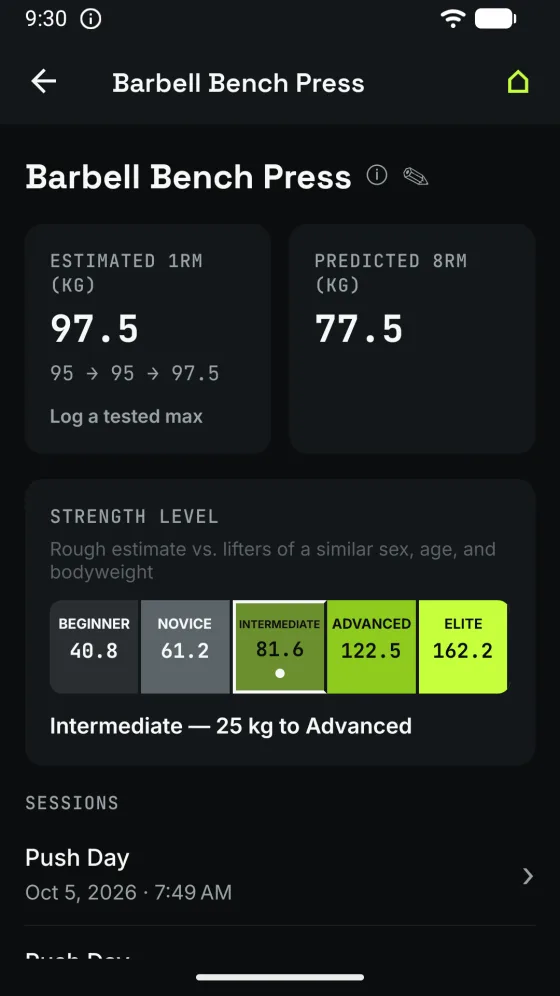
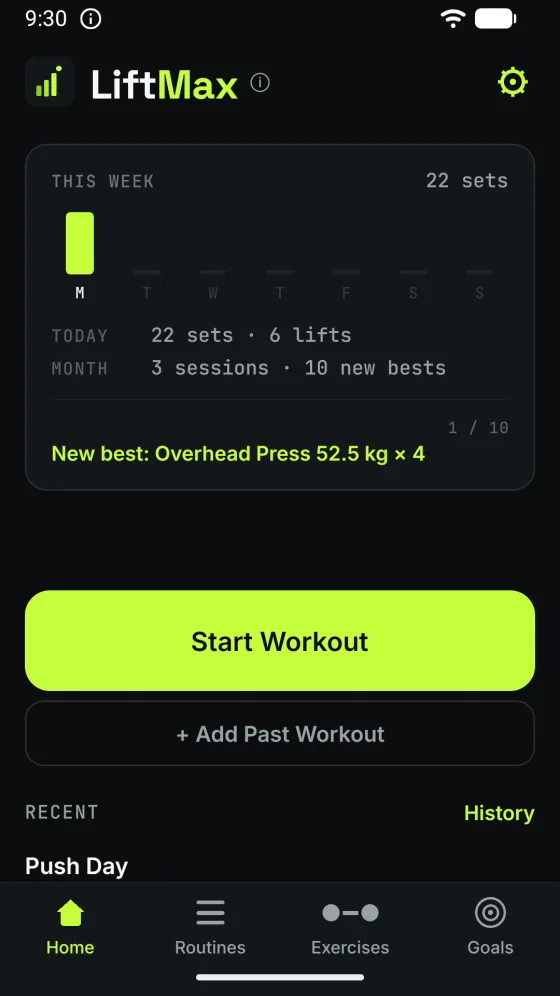
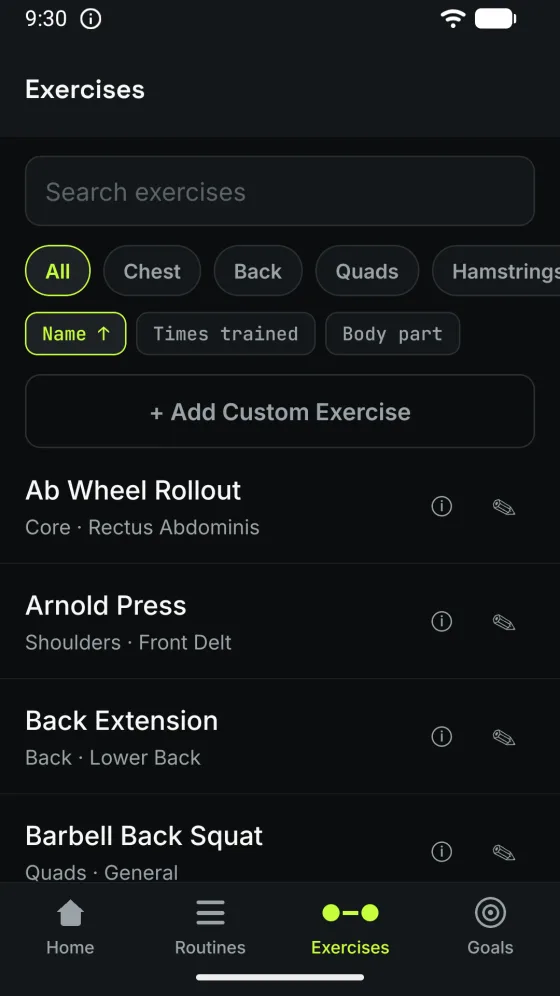
The prescription, and why it is that.What a session ends on.What you actually trained.Where each lift stands.Your week, and today's session.Over 200 exercises, plus your own.
The details
Built for the gym, not the spreadsheet
Weights you can actually load.
The model asks for 83.7 kg. What you get
depends on what the weight is made of:
Barbell2.5 kg steps82.5
Dumbbell2 kg steps84
Kettlebell4 kg steps84
Pin stack5 kg steps85
A pound gym gets its own table, not a conversion of this one — 2.5 kg
is 5.5 lb, and no barbell anywhere makes that.
Knows when a lift has run out of room.
Mark the top of the rack or the last pin on the stack, and it stops
prescribing past what the equipment holds — and says so, rather than letting the weight
sit still for weeks looking like a plateau.
“This is the most weight you've said this exercise can be
loaded to, so it stays there — add reps or find a heavier setup to keep progressing.”
Warm-up sets calculated before your first working set — a three-rung
ramp onto the same plate grid, and nothing at all below a load that doesn't need one.
A rest timer between sets, with an alert when it's up.
Over 200 exercises, with your own additions alongside them, and a
how-to guide on every one.
18 routine templates — body parts, splits, or built around the
equipment to hand.
Per-exercise overrides when the standard progression doesn't suit a
lift.
Personal bests and goals, and where a lift sits against general
strength standards.
Log past workouts you did away from the app. Kilograms or pounds.
LiftMax Pro
Plan the weeks ahead. Read back what they did.
The free app tells you what to lift today. Pro adds the block it
belongs to, and an honest read on how it's going.
One payment
No subscription
Every device on your store account
Programs
A multi-week block, planned for you.
Every session scheduled ahead of time, deload weeks included — no picking a
routine each day.
Build it yourself, or answer a few questions — goal, days a week, session length,
equipment, anything to work around — and get a draft you can change.
Miss a week and the block waits for you. Sessions run in order, not on dates.
A check-in while it runs, a review at the end, and any finished block can be run
again.
MaxStats
Your training, read back in plain words.
Opens on the verdict: how many lifts are going up, and what needs a look.
Hard sets per muscle each week, against what's enough and what's too much.
A muscle heat map, records, consistency, and how close you came to your
targets.
When you're on course to hit a goal.
Any date range — and a MaxStats tab on every exercise, routine,
program and workout.
Session insights
What today is doing to your targets.
While you lift: how today's fatigue is moving each target, and which
sets are carrying the session.
On any workout, running or finished.
Routine review
Advice, not just charts.
Which lifts are moving, and which have stalled.
What to change in the sets and reps.
A swap for a lift that has stopped.
The parts of a muscle the routine never reaches.
Why there's no subscription
There is no server behind LiftMax, so one more lifter costs nothing to run — and
there is no monthly bill to pass on. Buy it once and it unlocks on every device signed
in to the same Google Play or App Store account.
Free forever, Pro or not
Logging and history
Progression, every session
Backup and export
Reps-in-reserve calibration
Your personal rep-max curve
Strength standards
Warm-ups and the rest timer
No limit on exercises, routines or workouts
Pro adds to the app. It never takes anything away from it.
Privacy
Your data stays yours
No account. No sign-up. No ads.
Everything you enter — your profile, workouts, routines and history — is
stored in a database on your own device. There is no server holding your training history,
because there is no server.
Back up to your own Google Drive on Android or iCloud on iPhone, so a lost or
replaced phone doesn't mean starting over — encrypted if you want, and only if you switch
it on. Erase everything from within the app whenever you want.
Pro doesn't change any of that. The purchase is held by Google or Apple
against your store account; the app only asks whether that account owns it.
Anonymous crash reports are sent to help fix bugs. They contain technical
diagnostics only — never your training data. Details are in the
privacy policy.
Get in touch
Support
Questions, bug reports and feature requests all go to one inbox, and a
person reads them.
If you're reporting a bug, the Contact Us button in the app's
Settings fills in your build number automatically — that makes it much easier to track
down.